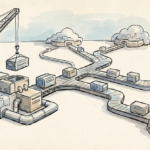
The Orchestration Reality Check Let me guess. You’ve got containers running in production, maybe some Docker Compose files scattered around, and you’re calling it “orchestration.” That’s like calling a bicycle a Ferrari because they both have wheels. Real container orchestration isn’t just about running containers somewhere. It’s about solving the fundamental problem of distributed systems:
The 3 AM Production Alert That Changed Everything Picture this: your monitoring system starts screaming at 3 AM because checkout queries are timing out. The database CPU is pegged at 98%. Users are abandoning carts faster than you can say “revenue impact.” You SSH into the production box, run EXPLAIN on the offending query, and
The Brutal Truth About Code Review ROI Let’s start with an uncomfortable fact: most code reviews are performative theater. Developers skim through changes, leave a few nitpicky comments about variable names, and rubber-stamp the approval. Meanwhile, the real architectural decisions, security holes, and maintainability disasters sail through unchallenged. I’ve watched teams spend twenty minutes debating
The Lambda Architecture Lie We All Bought Remember when Lambda architecture was going to solve all our real-time processing woes? Yeah, me too. I spent three years of my life implementing variants of Nathan Marz’s grand unified theory, complete with batch layers, speed layers, and serving layers that somehow never quite served what we actually
The Signal: FinOps is Dead, Long Live Autonomous Cost Management I’ve watched three generations of cloud cost optimization evolve in the wild. First came the Excel warriors of 2015, manually tagging resources like digital librarians. Then the FinOps evangelists arrived with their dashboards and governance frameworks. Both approaches share a fatal flaw: they assume humans
The 3 AM Wake-Up Call That Changed Everything Three years into my career, I got the call every junior engineer dreads. Production was down. Users were screaming. Revenue was hemorrhaging. The culprit? A cascading failure across our microservices that nobody understood, including the architect who designed it. Debugging Distributed Systems: The Unglamorous Skill That Built
When Your API Becomes Everyone’s Favorite Scapegoat Picture this: It’s 2 AM, Slack is lighting up like a Christmas tree, and three different teams are pointing fingers at your API because their integrations are mysteriously failing. You’ve been here before. The logs show HTTP 200s across the board, but somehow “success” means different things to
The Architecture Wars Nobody Wins Every few months, someone posts a “React vs Vue vs Angular” comparison that gets shared around like gospel. These articles usually focus on bundle sizes, GitHub stars, and job market demand. They miss the point entirely. The real question isn’t which framework is “best” – it’s understanding how each one
The Problem With Most API Design Advice Most API design articles read like they were written by someone who’s never had to explain to a sleep-deprived developer at 2 AM why their integration broke after a seemingly innocent update. They’re full of abstract principles and buzzwords but light on the specific decisions that separate APIs
We’re Still Debugging Like It’s 1999 Let me paint you a picture. It’s 2:47 AM, your pager is screaming, and somewhere in your 47-microservice mesh, requests are timing out with the enthusiasm of a DMV clerk on Friday afternoon. You fire up your observability dashboard, squint at a Jackson Pollock painting of metrics, and begin