Container Orchestration: Why Your Deployment Strategy Probably Sucks (And How to Fix It)
The Orchestration Reality Check
Let me guess. You’ve got containers running in production, maybe some Docker Compose files scattered around, and you’re calling it “orchestration.” That’s like calling a bicycle a Ferrari because they both have wheels. Real container orchestration isn’t just about running containers somewhere. It’s about solving the fundamental problem of distributed systems: how do you reliably deploy, scale, and maintain applications across a fleet of machines that will inevitably fail at the worst possible moment?
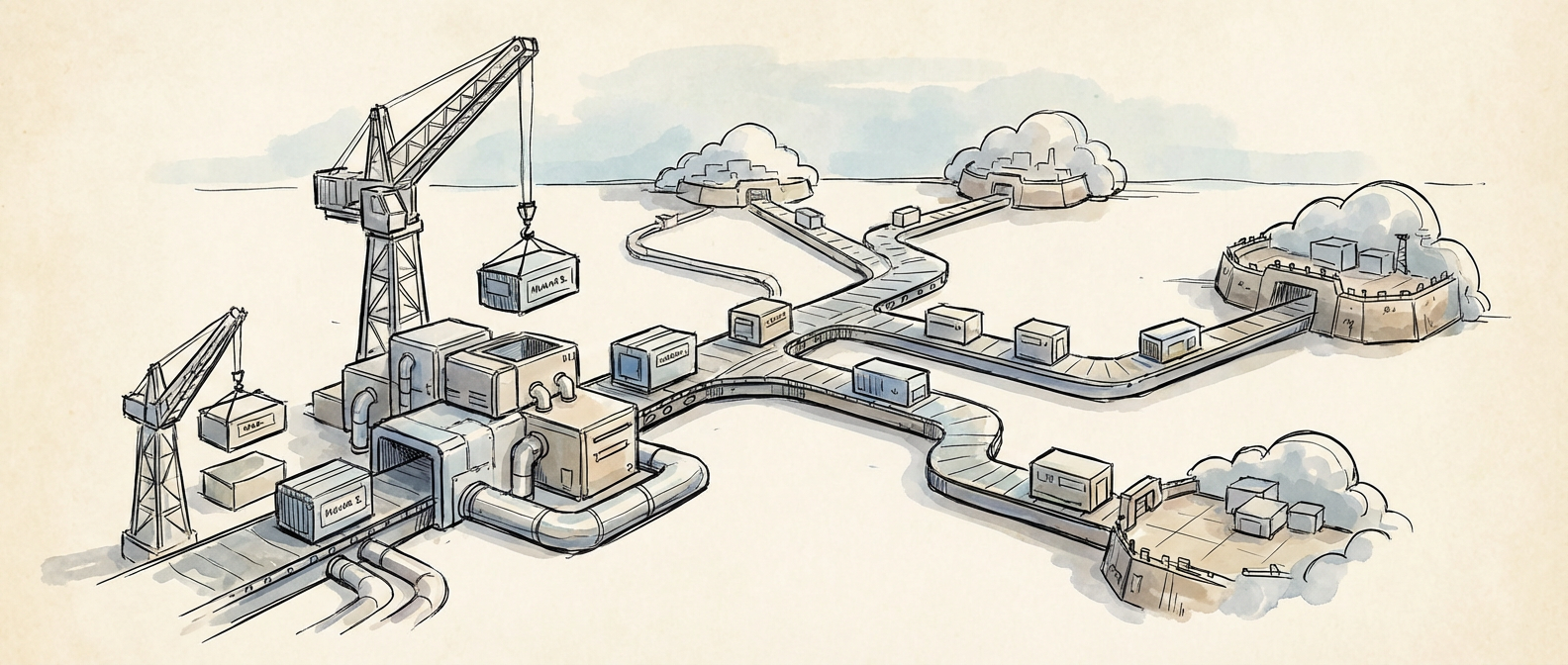
After spending the better part of a decade watching teams struggle with this, I’ve noticed a pattern. Most organizations jump straight to Kubernetes because “that’s what everyone uses” without understanding what problem they’re actually solving. They end up with a Byzantine mess of YAML files that nobody understands, deployments that take forever, and a production environment that feels like a house of cards in a hurricane.
The truth is, container orchestration is really about three core problems: placement, scheduling, and resource management. Everything else is just implementation details. Once you understand these fundamentals, the path to a sane deployment strategy becomes crystal clear.

Placement: The Art of Putting Things Where They Belong
Container placement is deceptively simple in concept but brutally complex in practice. At its core, you need to decide which containers run on which machines. Sounds easy until you factor in resource constraints, network topology, data locality, failure domains, and compliance requirements. Suddenly your simple scheduling problem becomes a multi-dimensional optimization puzzle that would make a mathematician weep.
The naive approach is round-robin scheduling. Put the next container on the next available machine. This works great until it doesn’t. Your database containers end up on the same physical host as your compute-heavy batch jobs. Your frontend services get scattered across availability zones, adding unnecessary latency. Your critical services share nodes with experimental workloads that might eat all available memory.
Smart placement strategies use constraints and affinity rules. Want your Redis cache close to your application servers? Use node affinity. Need to ensure your database replicas are spread across failure domains? Anti-affinity is your friend. Running stateful services? Use persistent volume topology to keep containers near their data. These aren’t just nice-to-haves. They’re the difference between a system that gracefully handles failure and one that falls apart when a single machine reboots.
But here’s where it gets interesting. Modern orchestrators like Kubernetes don’t just place containers once and forget about them. They continuously evaluate placement decisions. If a node becomes unhealthy, containers get rescheduled. If resource pressure builds up, pods can be evicted and relocated. This dynamic placement is what transforms a collection of containers into a self-healing system.
Scheduling: When Timing Is Everything
Container scheduling goes beyond just “start this container now.” It’s about managing the entire lifecycle of your workloads in a way that maximizes resource utilization while meeting performance and availability requirements. Think of it as the conductor of an orchestra, ensuring every instrument comes in at exactly the right moment.
The scheduler’s job starts with resource allocation. Your container needs 2 CPU cores and 4GB of memory. Simple enough, except those resources need to be available not just when the container starts, but throughout its entire lifecycle. A good scheduler understands the difference between requests (what you need) and limits (what you’re allowed to consume). It can pack containers efficiently while preventing resource starvation.
Then comes priority and preemption. Not all workloads are created equal. Your production API servers should take precedence over batch processing jobs. Critical system services need guaranteed resources even when the cluster is under pressure. A mature scheduling system can gracefully preempt lower-priority workloads to make room for more important ones, all while respecting graceful shutdown procedures.
The really sophisticated part is workload-aware scheduling. Different applications have different patterns. Some are CPU-bound, others are memory-heavy. Some need burst capacity, others require consistent performance. Some are latency-sensitive, others can tolerate delays. A scheduler that understands these patterns can make placement decisions that optimize for the specific needs of each workload, not just generic resource metrics.
Resource Management: The Physics of Containers
Resource management in container orchestration is where theory meets the harsh reality of physics. You have finite CPU, memory, storage, and network capacity. Your job is to divide these resources among potentially hundreds or thousands of containers in a way that maximizes utilization while preventing any single workload from bringing down the entire system.
The foundation is resource isolation. Containers should be good neighbors. That means setting appropriate CPU limits so your machine learning training job doesn’t starve your web servers. It means configuring memory limits so a memory leak in one application doesn’t trigger the out-of-memory killer for everything else on the node. Here’s the thing: not all resources are created equal. CPU can be throttled gracefully. Memory cannot. Plan accordingly.
Quality of Service (QoS) classes add another layer of sophistication. Guaranteed pods get exactly the resources they request. Burstable pods can use more than they request if available. Best-effort pods get whatever’s left over. This hierarchy allows you to mix critical production workloads with batch processing and development environments on the same infrastructure without performance conflicts.
But resource management isn’t just about preventing bad things from happening. It’s about enabling good things. Vertical Pod Autoscaling can automatically adjust resource requests based on actual usage patterns. Horizontal Pod Autoscaling can spin up additional replicas when demand increases. Cluster autoscaling can add nodes when you need more capacity and remove them when you don’t. The result is infrastructure that adapts to your workload instead of forcing your workload to adapt to fixed infrastructure.
Deployment Strategies: Beyond Blue-Green
Most teams think deployment strategy begins and ends with blue-green deployments. Create a new environment, deploy your changes, switch traffic over. It’s simple, it’s safe, and it requires twice as much infrastructure as you actually need. For some use cases, that’s fine. For others, it’s expensive overkill.
Rolling deployments offer a middle ground. Update containers gradually, a few at a time. If something goes wrong, you catch it before it affects all your users. The orchestrator handles the complexity of maintaining service availability while containers are being replaced. You can tune the rollout speed based on your risk tolerance and resource constraints. Fast rollouts mean quicker deployments but higher risk. Slow rollouts are safer but take longer.
Canary deployments take this further. Deploy the new version to a small subset of users. Monitor metrics carefully. If everything looks good, gradually expand the rollout. If problems emerge, roll back immediately. This approach catches issues that might not appear in testing but becomes obvious under real-world load patterns. The key is having robust monitoring and automated rollback criteria so you can catch problems before your users do.
The most sophisticated deployment strategies use traffic shaping and feature flags. Deploy new code everywhere but control which users see which features. This decouples deployment from release, allowing you to deploy changes safely and enable features independently. You can test changes with internal users before exposing them to customers. You can gradually ramp up new features to different user segments. When something goes wrong, you can disable a feature without redeploying code.
The best deployment strategy for your team depends on your specific requirements. How much downtime can you tolerate? How quickly do you need to roll back changes? How much extra infrastructure can you afford? There’s no one-size-fits-all answer, but understanding the trade-offs helps you make informed decisions instead of just copying what everyone else is doing.
Container orchestration done right transforms deployment from a nerve-wracking manual process into a reliable, automated system. The learning curve is steep, but the payoff is enormous. Once you’ve experienced the confidence that comes from knowing your deployments will work reliably, it’s hard to go back to the old way of doing things. What deployment challenges are you facing? I’d love to hear about your experiences and the solutions you’ve discovered along the way.

The One Thing to Do If You Need a Credit Card Without a Social Security Number
The Open Source Foundation: How Free Software Became the Backbone of Digital Infrastructure
Swift Property Wrappers: The Hidden Price of Syntactic Sugar
About Author
